
Written and medically reviewed by Prof Dr Srinjoy Saha, MS, MCh (Plastic Surgery), FACS, FRCS (Glasgow) · Last reviewed: 30 July 2026


28+ Years Experience • 8,000+ Treatments • PSF Achauer Award • Gold Medal • Harvard-Trained
Rhinoplasty — also called nose surgery or a nose job — reshapes the nose to improve its appearance, its breathing function, or both. It is among the most technically demanding operations in plastic surgery, because millimetres are visible, the structures being altered support each other, and the result has to work as an airway as well as look right.
Rhinoplasty may typically take around 1–4 hours under local or general anaesthesia, and require a splint for about 5-7 days. Most swellings settle in 6–8 weeks; final shape appears over 12-18 months in Indian noses. Structural techniques that reinforce the nasal framework give more durable results in Indian noses than reduction alone.
Rhinoplasty in Kolkata costs approximately ₹60,000 to ₹3,50,000. What determines your costs ↓
Examples of Surgical Approaches to Nose Deformity


What Can a Nose Surgery Correct?
Is nose surgery the same as rhinoplasty?
Yes. Rhinoplasty is the medical term for nose surgery, also called a nose job. When a deviated septum is corrected at the same time to improve breathing, the operation is called septorhinoplasty.
Why Surgical Experience and Expertise Matters in South Asian Rhinoplasty
The three problems specific to a South Asian nose
-
Skin over the South Asian nose is thicker, with more soft tissue over the tip. Thick skin conceals fine changes to the underlying framework, which means refinement depends on structural change rather than on removing cartilage — and it means swelling takes longer to settle, so the result appears later.
-
Lower lateral cartilages are often weaker and less springy. A technique that relies on trimming cartilage weakens an already weak framework, and the nose collapses or distorts over the following years.
-
The nasal base is commonly wider and tip projection lower. The nose surgery is more often about adding projection and augmenting structures that support the nose rather than reducing them.
Reduction rhinoplasty is an approach developed for thin-skinned, strongly cartilaginous noses, based on taking structure away. When applied unmodified to a South Asian nose produces a poor result: a tip that stays bulbous because thick skin has not redraped, a bridge that looks scooped, and a framework too weak to hold position.
Structural rhinoplasty, which reshapes and reinforces with grafts rather than resecting, is generally the appropriate approach, and often the nose is augmented in places rather than reduced.
What goes wrong in South Asian rhinoplasty?
-
Take too much away and the tip pinches or the bridge collapses.
-
Correct the shape without opening the airway and you get a patient who looks better and breathes worse.
These two result in the commonest complaints seen in revision rhinoplasty of South Asian noses.
The Challenge | The Implication | The Approach |
|---|---|---|
Thicker Skin | Holds swelling longer; hides definition | Regenerative techniques used to support steady healing and tissue integration |
Softer Cartilage | Prone to collapse and asymmetry | Structural reinforcement - use grafts rather than simple reduction |
Variable Dorsum | Requires Micro-precision and Balance | Sculpting proceeds in small increments, because thick skin conceals large ones |
Open or Closed Rhinoplasty
Open approach is more often appropriate in thick-skinned noses, in significant tip work, in correction of asymmetry, and in revision nose surgery. It gives direct vision for tip work, graft placement and revision. The scar sits in a natural shadow and generally settles inconspicuously.
What Prof. Saha Does Differently & Why It Matters
The nose surgery is planned as a reconstruction. Structure is added more often than it is removed.
Regenerative techniques such as PRP and bioabsorbable scaffolds are used selectively, based on the patient’s anatomy and the best available evidence. Techniques used here are described in peer-reviewed work published in the Journal of the American College of Surgeons.
How he plans a nose surgery


Structural Rhinoplasty: Comparing Options
Structural rhinoplasty uses cartilages or bioabsorbable implants to support, reshape and reinforce the nasal structures. The graft or scaffold is chosen case by case, after an examination, based on what your nose needs and what remains available.
The four options, compared:
Graft Source | What It Costs You | Can It Warp Later | When It Is Chosen |
|---|---|---|---|
Important points the table cannot show.
Volume is not a reason to take a rib.
Septal and ear cartilage run out; a scaffold is shaped to the plan rather than to whatever the donor site happened to yield. A large nasal deformity is not, by itself, an argument for a chest wound.
The scaffold works because of how slowly it goes.
The polycaprolactone lattice is an open architecture, so your own tissue grows through it from the time it is placed, and it resorbs over years rather than months. So, by the time the polymer has gone, the tissue that replaced it is mature and carrying the load. There is no window in which support has been lost and nothing has taken over. The material has been in surgical use for around thirty years and in 3D-printed cranio-facial reconstruction, including covering skull defects, for around twenty years. Its safety profile is well-documented. What it will not do is replace cartilage where a large volume of structural tissue is missing. In that situation rib remains the operation.
Which of the four is right for you?
This key decision is taken after the consultation is over, based on what is missing in your nose and what remains available. It is not based on any personal preference that can be decided in advance.

Revision Rhinoplasty.
A proportion of the rhinoplasty performed here is correction of previous surgery elsewhere. If you are unhappy with your previous outcome, a full assessment is needed to determine what is achievable.
Revision is substantially harder than primary surgery.
The tissue planes are scarred, the anatomy is no longer predictable, cartilage has often been removed and is not available for grafting, and the skin envelope may have contracted. Common problems presenting for revision are an over-reduced dorsum, a pinched or asymmetric tip, an over-rotated short nose, breathing obstruction caused by loss of structural support, and irregularity visible under thin skin.
Revision usually requires adding structure rather than removing it.
That is why a graft source is a central part of planning. Where septal cartilage was used at the first operation, ear or rib is needed. Bioabsorbable implants now provide an alternative.
Deficient results usually come from a plan rather than a slip.
Structures that the nose needed was removed, or the healing problems of thick skin was never explained. Technique matters too — a graft in the wrong position stays in the wrong position. But, the commonest cause is the decision taken before nose surgery even started.
Timing of revising nose surgery matters. A lot.
Except where breathing is obstructed, revision generally waits for the tissues to settle after the previous operation. Six months of gap is necessary at the earliest, though a year's gap is preferred. This time lag is necessary because operating inside swollen, actively remodelling tissue produces an unpredictable result.
Not every problem after rhinoplasty is fully correctable, and the assessment says so plainly.
Cleft Nose Deformity.
The nasal deformity associated with cleft lip involves asymmetry of the nostril and tip, deviation of the septum and columella, and a flattened alar cartilage on the affected side.
It is a complete nose reconstruction rather than a cosmetic adjustment, usually undertaken after facial growth is complete, and frequently requiring structural grafting to rebuild support on the affected side.
Who Is a Candidate For Rhinoplasty
Problems in nasal shape corrected by rhinoplasty include the following:

Dorsal Hump.
A visible bump on the nasal bridge that disrupts facial balance or profile harmony.

Wide or Flared Nostrils.
Excessive nasal width or alar flaring - affects proportion, especially on frontal view.
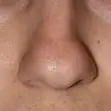
Bulbous / Droopy Tip.
Poor tip definition due to weak cartilage support, thick skin, or downward rotation.

Thick Nasal Skin
Thick, oily skin that hides nasal definition and requires integral support structures.

Septal Deviation
Nasal blockage due to septal deviation or valve weakness, with cosmetic concerns.

Unsuccessful Surgery
Residual asymmetry, collapse, pinching, or breathing issues after prior surgery.
What rhinoplasty can and cannot do
Rhinoplasty improves balance, not perfection.
Faces are naturally asymmetrical. Surgery aims for balance, not mathematical perfection.
Breathing can improve, but anatomy sets limits.
Functional correction is planned carefully, but outcomes depend on internal structure and tissue quality.
Healing takes time.
Swelling settles in stages. Final refinement often takes 12-18 months, especially in thick skinned South Asian noses.
Thick skin behaves differently.
Definition appears gradually and subtly. Over-reduction does not produce better results.
Revision risk exists — even with expert planning.
Meticulous planning reduces risk, but biology and healing responses cannot be fully controlled


Age and Timing
Rhinoplasty is generally deferred until facial growth is complete — broadly from the mid-teens in girls and slightly later in boys — because operating on a growing nose can affect its subsequent development.
Functional surgery for a significantly obstructed airway may be undertaken earlier where the indication justifies it.
There is no upper age limit, though skin quality and healing change with age.
Anaesthesia and Nose Surgery
General anaesthesia in most cases.
Operating time varies widely with complexity — a limited dorsal correction is short, a revision with rib grafting is long.
An external splint is worn for about 5-7 days. Internal splints are sometimes used.
Nasal packing is used selectively rather than routinely. Most patients go home the same day or after one night.
Rhinoplasty Procedure: Stepwise Overview


Rhinoplasty fails when structure, airway, and healing biology are treated separately. In his surgical approach, Prof. Saha plans all three together and executes them consistently.
Risks & Complications
- Persistent swelling, particularly of the tip
- Asymmetry
- Irregularity or a visible edge of the dorsum, more likely with thin skin
- Under-correction or over-correction
- Breathing obstruction, including from valve collapse after reduction
- Bleeding
- Infection
- Graft-related problems — resorption, displacement, visibility, warping of rib cartilage
- Altered or reduced sense of smell, usually temporary
- Numbness of the tip, usually temporary
- Septal perforation — uncommon
- Skin problems over the nose, more likely in revision and in smokers
- Donor site discomfort and scarring where ear or rib is used
- Anaesthetic risks, assessed separately
- Revision surgery
Recovery & Swelling Timeline
This part needs to be stated clearly in advance.
First week. Splint on. Swelling and bruising around the eyes, worst at two to three days, then improving. Blocked nose. Sleeping propped up helps.
Days 5-7 · splint removed.
Week 2 · most feel comfortable going out in public.
Week 6–8 · swelling settles down in most people.
Month 3 · nose shape starts getting recognisable.
Month 12–18 · final nose shape refinement, longer for thick skin.
Exercise is restricted for around six weeks, contact sport considerably longer. Glasses should not rest on the bridge for six weeks where bone was cut; four weeks for tip-only work.
Judging results at three months is judging it early. Judging it at one month is judging something that is not the result at all.
Before you book your nose surgery
Ask any surgeon, including this one:
-
What is your specialist qualification in plastic surgery, and when did you obtain it?
-
How many revision rhinoplasties have you done in the last two years?
-
Where will the operation be performed, and is a consultant anaesthetist present throughout?
-
What graft will you use, and what is your second choice if the first is not available?
-
If I need a revision, who pays for it?
-
What will my nose look like at three months, and how is that different from the final result?
Cost of Rhinoplasty in Kolkata
Rhinoplasty in Kolkata costs approximately ₹60,000 to ₹3,50,000.
The range is wide because cost depends on the complexity of the case: whether the septum also needs correction, whether cartilage grafts are required, whether it is a primary or a revision operation, and the length of anaesthesia and hospital stay.
An approximate figure can be provided after examination at consultation. Any figure quoted before examination is a guess. Revision with rib grafting is a substantially longer operation than a primary dorsal correction and increases the costs accordingly.
Where surgery corrects a documented breathing obstruction, the functional component may be considered by your insurer. What to gather, and when to raise it, is set out on the costs page.
What the quoted figure includes
Surgeon's fee, anaesthetist fees, surgery and anaesthesia assistance fees, operation theatre charges, equipment charges, implants or grafts, hospitalised medicines, hospital stay, splint and dressings, consumables.
What it does not include
Pre-operative investigations, medication after discharge, post-operative care, revision surgery, travel and accommodation.
Consultation fees, GST, applicable taxes, deposits, quotation validity, revision charges and what to ask before comparing any quotation: What a quotation includes, consultation fees, insurance and revisions
Factor | Effect on cost |
|---|---|
Hospital stay | Lengthy stay more costly |
Length of anaesthesia | Longer procedures cost more |
Cartilage grafts or scaffolds | Adds lengthy operative costs or material costs |
Septal correction for breathing | Adds surgical time |
Primary vs revision rhinoplasty | Revision is more complex and costs more |
Frequently Asked Questions (FAQs)
-
Why does my nose look bigger in photographs?
Because of camera distance, not because of your nose. A phone held at arm's length is close enough that perspective enlarges whatever is nearest the lens — which is the nose — and widens the base. The same face photographed from a normal conversational distance looks noticeably different. Many people seeking rhinoplasty are responding to a distortion rather than to their appearance, and this is worth understanding before deciding on surgery.
-
Will there be a visible scar?
Closed rhinoplasty leaves none externally. Open rhinoplasty leaves a small scar across the columella, which sits in shadow and generally becomes inconspicuous.
-
How do you ensure my new nose looks natural and fits my face?
By measuring rather than by style. Skin thickness, cartilage strength, the position of the septum and the projection of the chin are assessed at examination, and the plan follows from those. A nose that fits one face will not fit another, which is why the same operation is not offered to everyone.
-
Why is rhinoplasty for Indian noses considered more complex?
Patients with thicker skin and softer cartilage may require structural reinforcement rather than aggressive tissue removal. A "Regenerative-First" approach uses growth factors to support tissue integration during a healing process that is slower in thick skin, not faster.
-
When will I look normal?
Presentable in public at around two weeks. Shape recognisable at three months. Settled at a year or more, longer for the tip in thick skin.
-
Can it fix my breathing?
Where the obstruction is structural — septum, turbinates, valve collapse — usually yes. Where allergy or mucosal disease contributes, that needs treating separately.
-
What is the "Regenerative" step in your surgical process?
A Regenerative-first technique involves the use of growth factors and bio-absorbable scaffolds to reinforce cartilage grafts. The aim is better graft integration and less stiffness in the healed tissue. It does not shorten the swelling timeline and it is not a substitute for structural support.
-
What does the recovery timeline look like?
Most cases require a short hospital stay with next-day discharge. You will wear a splint for 5–7 days, with a gradual return to normal activity shortly after. While major swelling reduces over weeks, the final refined contour emerges progressively over 12–18 months in Indian noses.
-
I’ve had a previous "botched" surgery. Can you fix it?
Yes. Revision is a substantial part of the work here, usually after over-reduction or a plan that removed support the nose needed. It is harder than primary surgery and it is quoted accordingly. Not every problem is fully correctable, and you will be told which parts of yours are.
-
Are non-surgical alternatives worth considering?
Fillers can camouflage a small dorsal irregularity or add projection in selected cases. They cannot reduce anything, they do not treat breathing, and injection in the nose carries specific vascular risk. It is a limited option, not a substitute.
-
Should I fix my chin at the same time?
Sometimes. A recessed chin makes a nose appear larger, and addressing both produces better balance than operating on the nose alone. Assessed at consultation.
Photographs in This Page
Every photograph in this section is of an actual patient of Prof. Dr Srinjoy Saha, published with that patient's specific written consent for publication. Images are unretouched apart from standardised cropping and lighting, and are taken under consistent conditions before and after surgery. Any image illustrating a concept rather than a patient is that of a Model.
Surgical outcomes depend on individual anatomy, skin thickness, tissue quality and healing. Individual results vary. No image here is a promise or prediction of your result.
Consult Prof. Srinjoy Saha
Prof. Srinjoy Saha is a Harvard-trained surgeon-scientist and a Member of the Regenerative Medicine Committee of the American Society of Plastic Surgeons. He is the only Adjunct Professor of Plastic Surgery in Apollo AHERF among their 245 India-wide faculty list. He is a Fellow of the Royal College of Physicians and Surgeons of Glasgow and the American College of Surgeons.
He is an experienced rhinoplasty surgeon who has seen enough complications to be careful, and enough good outcomes to be calm. He analyses every nose surgery case individually, and operates accordingly. He works to a regenerative-first protocol he calls the Jyoticision™ System
Frequently, he receives complex and revision rhinoplasty cases referred from across India.
YOUR NEXT STEPS
Rhinoplasty assessment covers nasal analysis in relation to facial proportions, skin thickness by examination, cartilage strength, septal position, internal examination of the airway, chin projection — a weak chin makes any nose look larger, and assessing it is part of a rhinoplasty consultation — and standardised photography.
Afterward, a discussion of what is achievable in your case and what is not, graft or implant planning where relevant, review of medical history and medication, and the risks specific to you.
A personal consultation will clarify what is achievable for your anatomy and goals. Consultations are chargeable.


