Why Does My Nose Look Bigger in Selfies? The Science of Selfie Distortion — and What to Check Before Cosmetic Surgery
Yes, your nose does look flawed in selfies — and it is the camera, not your nose. A phone held at 30 cm measurably changes the proportions of your face. Understanding how — and by how much — can save you from planning surgery around a flaw the camera's distance created.

The same person, the same lighting, thirty seconds apart. Left: front camera, elbow bent (~30 cm). Right: rear camera, 1.5 m.
Nothing about the face changed — only the distance did.
Key takeaways
-
Your nose is not the problem; 30 cm is. At arm's length the nasal base photographs about 30% wider than it does at 1.5 metres — the distance from which other people actually see you.
-
The numbers, from two studies. A mathematical model in JAMA Facial Plastic Surgery found the nasal base appears about 30% wider at elbow-bent distance — about 30 cm — than at 1.5 m. A clinical study of 30 volunteers found the nose reading about 6.4% longer, while the chin lost roughly 12% of its apparent height, compared with a standard clinical photograph.
-
The cause is mostly distance, not the lens. Features nearest the camera enlarge; features further back shrink.
-
US surveys of facial plastic surgeons report selfie-driven requests rising from 42% of surgeons in 2016 to 72–75% within about five years (comparator data; no equivalent published Indian dataset that I am aware of).
-
"Snapchat dysmorphia" and "Zoom dysmorphia" are descriptive labels, not medical diagnoses. The recognised condition behind them is body dysmorphic disorder (BDD) — and UK guidance (NICE CG31) says people with suspected BDD seeking cosmetic surgery should first be assessed by a mental-health professional.
-
Before considering any facial procedure, review a photograph taken from about 1.5 metres. If distress about a feature persists on an accurate image, a mental-health assessment should come before surgical planning — not after.

What is selfie distortion?
Selfie distortion is the change in your face's apparent proportions when it is photographed from very close range. In plain terms: the parts of your face nearest the camera — nose, lips, cheeks — are projected larger, while parts further back — ears, jaw angle, hairline — are projected smaller. Photographers call this perspective distortion.
You can feel the principle with a one-second experiment: hold your thumb a hand's width from one eye and it looms over the room behind it. Nothing about your thumb changed; only its distance did. At 30 cm, your nose is your thumb.
Clinical Vignette: A drawing that ended all surgical plans
A seventeen-year-old came to the clinic unhappy with her nose. Her parents came with her, and their worry was not the nose at all: she had stopped studying. The books were closed. The hours were going somewhere, and where they were going was the phone. She showed me the evidence she had been judging herself on — selfie after selfie — and explained that she could not post a photograph of herself the way her friends could.
On examination, her nose was unremarkable. There were minor irregularities of the kind almost every nose has and almost nobody notices.
I gave no opinion on the nose that day. I asked her to do something else first: go to a photographic studio, have proper photographs taken in diffuse light from five angles, and then, at home, draw onto those photographs the nose she wanted.
She came back with the drawings. She had drawn her ideal nose directly onto the accurate images — and the line she drew ran along the border of the nose she already had.
The nose she wanted was the nose she owned. She had simply never seen it. Months of distress had been produced entirely at thirty centimetres. No rhinoplasty was planned, because there was nothing for a procedure to do: the anatomy already matched the ideal. What stood between them was not her nose. It was the camera.
She went back to her books. Not that afternoon — it took time for the drawing to mean what it meant. But the hours came back, and the books opened again.
That is the most useful thing that happened in this case, and I did nothing to it. The distortion was not a symptom of her problem. It was her problem, and removing it was the whole treatment.
Had the distress outlived the drawing, the next appointment would have been with a psychologist, not with me. That is the pathway, and the drawing is what tells you which side of it you are on.
Published with the patient's and her parents' consent.

How do wide-angle lenses aggravate distortion in selfies?
The wide-angle lens on a front camera is often blamed, but it plays a supporting role. Its main effect is behavioural: a wide lens lets you fit your face into the frame from very close, so that is where people shoot from. Pull the same camera back to portrait distance and the proportions largely correct themselves, with no software needed.
A second, separate effect: faces near the edge of a wide-angle group photo get stretched sideways. That is a different mechanism (marginal distortion) and is why the person at the end of a group selfie sometimes looks unusually broad. This article focuses on the first effect — the close-range one — because it is the one that shapes how people judge their own features.

How much does a selfie change your face?
At about 30 cm, published research reports the nasal base appearing roughly 30% wider and the nose about 6% longer than in a standard photograph taken from 1.5 metres.
Two studies, using different methods, point the same way:
-
A mathematical model (Ward, Ward, Fried & Paskhover, JAMA Facial Plastic Surgery, 2018) built from averaged facial measurements of a racially and ethnically diverse US sample found that a selfie at about 30 cm makes the nasal base appear approximately 30% wider (30% in men, 29% in women) and the nasal tip about 7% wider than a photograph at 1.5 metres. This is a geometric model, not a patient study — a limitation the authors state. Its senior author's motivation is telling: he developed it because patients kept judging their noses from selfies, and he needed a way to show them the image was not trustworthy evidence.
-
A clinical measurement study (Pressler, Kislevitz, Davis & Amirlak, UT Southwestern, Plastic and Reconstructive Surgery, 2022) photographed 30 volunteers three times each — at 30 cm (elbow bent), 45 cm (arm extended), and 1.5 metres with a professional camera — under identical lighting, then measured facial landmarks. Compared with the standard clinical photo, the nose measured on average 6.4% longer at 30 cm and 4.3% longer at 45 cm; the chin was about 12% shorter at 30 cm; and the nose-to-chin ratio increased by about 17%. The authors note their limits plainly: thirty volunteers, one brand of phone. The direction of the findings, not the decimal points, is the reliable part.
Note what these results mean together: the selfie does not simply enlarge one feature. It enlarges the centre of the face and shrinks the lower face at the same time, so the overall balance shifts — which is exactly the kind of change people misread as "my nose is too big" or "my chin is too weak." The two most common photo-driven complaints I hear are, in part, the same optical event described from two directions.
How camera distance changes what you see
-
Front-camera selfie, elbow bent (about 30 cm): nose noticeably wider and longer, chin shortened, overall facial balance skewed.
-
Front-camera selfie, arm extended (about 45 cm): the same distortion, milder — the measured nasal lengthening roughly halves.
-
Rear camera, propped up, you step back (1 metre or more): substantially more accurate.
-
Clinical or portrait photograph (about 1.5 metres, longer lens): proportions close to how others actually see you.
-
Filtered or "beautified" image (any distance): not a photograph of you at all — software has redrawn the anatomy.

Why does this matter before cosmetic surgery?
Because the photograph is where many surgical wishes are now born.
In annual surveys by the American Academy of Facial Plastic and Reconstructive Surgery, the share of member surgeons reporting patients motivated by their appearance in selfies rose from 42% in 2016 to 55% in 2017, 72% by 2019 and 75% in the survey reported in early 2021. Those figures describe the United States, not India.
I am not aware of an equivalent published Indian dataset on selfie-driven requests for cosmetic procedures. That absence matters. India has one of the world’s largest smartphone populations and a rapidly expanding aesthetic sector, yet we are still measuring this phenomenon almost entirely with data from other countries.
India may be experiencing a major change in how people judge their faces, but we do not yet have Indian data capable of measuring it. We should not assume that surveys from another country fully capture what Indian patients are seeing, requesting or experiencing.
In my Kolkata practice, I increasingly meet patients whose concern began or intensified through close-range selfies, beauty filters or video calls. That is a clinical observation, not prevalence data — but it is a strong reason for India to study the question systematically.
Part of the mechanism is simple exposure. A mirror shows a living face in motion; a phone shows the same frozen frame again and again — and repetition, more than accuracy, is what makes an image feel true.
In 2018, a viewpoint in JAMA Facial Plastic Surgery (Rajanala, Maymone & Vashi) described patients bringing filtered or distorted selfies as their surgical reference — a pattern that acquired the nickname "Snapchat dysmorphia."
During the pandemic, dermatology researchers (Rice, Graber & Kourosh, 2020) described a related pattern they called "Zoom dysmorphia": prolonged self-viewing on distorted video-call feeds. In their follow-up survey of more than 100 dermatologists, over half reported a rise in cosmetic consultations, and among those, more than 85% said patients cited their video-call appearance as a reason.
Both labels deserve precision. Neither is a diagnosis. The recognised condition is body dysmorphic disorder — BDD, a mental-health condition in which a person is intensely preoccupied with a perceived flaw that others see as minor or cannot see at all. BDD existed long before smartphones. Specialists still debate whether selfie culture is a new disorder or simply an old condition meeting a new provocation. What is not debated is the practical pattern: more people are judging their faces from images that misrepresent them.
What selfie distortion does not explain
Honesty requires the other side. This research does not show that every appearance concern is a camera artefact, and it does not show that cosmetic surgery is misguided:
-
Some features genuinely bother people in the mirror, in motion, and at every distance. Those concerns are real, and for suitable candidates, well-planned surgery can address them.
-
The measurement studies are small or model-based, and the clinical study used a single phone brand. They establish the direction and rough size of the distortion, not a precise prediction for your individual face.
-
Rising selfie-driven requests are an association, not proof that selfies alone cause surgical demand. Social media, filters, and video calls act together.
The point is narrower and more useful: before you conclude a feature needs changing, make sure the evidence you are judging it by is accurate.

Why a surgeon plans for the whole face, not the photographed feature
Selfies train a particular habit of attention: they crop the face into parts and invite you to audit each part on its own. A nose in profile. A chin at close range. Eyes under harsh front light. But faces are not perceived as inventories — they are perceived as relationships. Strengthen a recessed chin and the nose appears smaller without ever being touched. Balance a heavy brow and the eyes read as more rested. Every feature borrows meaning from its neighbours.
This is why experienced surgical planning starts from proportion and identity rather than from an isolated measurement. What a natural result actually means, in my experience, is what most people are actually asking for. Someone pointing at one feature is rarely asking to look like a different person. She is asking for that feature to stop demanding her attention every time a camera comes out. The goal is quiet relief, not transformation, and the results that achieve it tend to share a quality: they respect the surrounding architecture of the face instead of dominating it. Work that blends in goes unremarked — people notice someone looks well without being able to say why. Work that overrides the face announces itself.
One more consequence follows, and it is rarely discussed: the distortion does not stop operating after surgery. A well-proportioned result can look exaggerated in a 30 cm front-camera frame for exactly the same optical reasons the original "flaw" did. Outcomes should be judged the way they were planned — standardised photographs, same distance, same light — or the optics that manufactured the first complaint will quietly manufacture doubt about a good result.

Who should pause before planning a procedure?
Consider a deliberate pause — and a conversation with a mental-health professional before a surgical one — if any of these apply:
-
The feature distresses you in selfies but looks unremarkable to you in a mirror or in photographs taken from proper distance.
-
Your surgical reference image is a filtered version of yourself. A filter is not a preview; it redraws anatomy that surgery may not be able to reproduce.
-
The distress persists even after you review an accurate, well-lit photograph taken from about 1.5 metres. Persistence in the face of accurate evidence is itself meaningful — it suggests the concern may lie in perception rather than anatomy, and perception is treated by clinicians who treat perception, not by operations.
-
Checking, comparing, or editing images of your face occupies a significant part of your day, or you avoid photographs and social situations because of one feature.
This is not a personal opinion; it is the direction of formal guidance. The UK's NICE guideline on BDD (CG31) recommends that people with suspected or diagnosed BDD who are seeking cosmetic surgery or dermatological treatment be assessed by a mental-health professional with specific expertise in BDD, and that BDD specialists work in partnership with cosmetic surgeons so that agreed screening is in place.
The reason is outcomes: a systematic review commissioned by the UK Department of Health (2013) found that cosmetic surgery often did not improve psychological conditions such as BDD and in some cases made them worse, while psychological and medical treatment was more effective — a conclusion echoed in the ethics literature, which reports that people with BDD are often dissatisfied after cosmetic procedures because the underlying perception, not the anatomy, is the problem.
BDD is treatable — typically with psychological therapy and, in some cases, medication. Seeking a psychological opinion is not a dismissal of your concern. It is the correct first treatment for a specific, recognised condition — and it costs far less, in every sense, than an operation that cannot fix it.

What do safeguards look like elsewhere — and here?
Several health systems now build the possibility of a "lying camera" into their rules. All of the following are international comparators:
-
United Kingdom. The Royal College of Surgeons' Professional Standards for Cosmetic Surgery (2016) require consent to be obtained in a two-stage process with a cooling-off period of at least two weeks between the stages, ban financial inducements such as time-limited offers, and address the care of psychologically vulnerable patients. NICE guideline CG31 sets the BDD screening-and-referral pathway described above. The scale of the underlying issue is public record: a 2022 House of Commons committee survey found 80% of respondents felt their body image negatively affected their mental health.
-
Australia. Since 1 July 2023, the Medical Board of Australia's cosmetic surgery guidelines require a referral, at least two consultations (one in person with the operating practitioner), screening for BDD using a validated tool, and a cooling-off period of at least seven days after informed consent before surgery can be booked or a deposit paid. Patients under 18 must be independently evaluated by a psychologist, psychiatrist or GP and observe a cooling-off period of at least three months.
-
India. I am not aware of an equivalent statutory cooling-off or screening mandate for cosmetic surgery here in India. In the absence of a mandated pause, the pause has to be built into good practice — which is a choice each surgeon and each patient can make regardless of regulation.
In my own practice: rhinoplasty and other facial procedures are never planned on the evidence of a selfie. Prospective patients supply photographs taken from proper portrait distance — or we take standardised clinical photographs — and then mark on that accurate image the specific changes they envisage.
Two things happen regularly. Some concerns shrink or disappear once the distortion is removed, and no procedure is planned. Other concerns remain visible on the accurate image, and those we can assess properly, discuss honestly — including what surgery cannot achieve — and plan with a built-in reflection period.
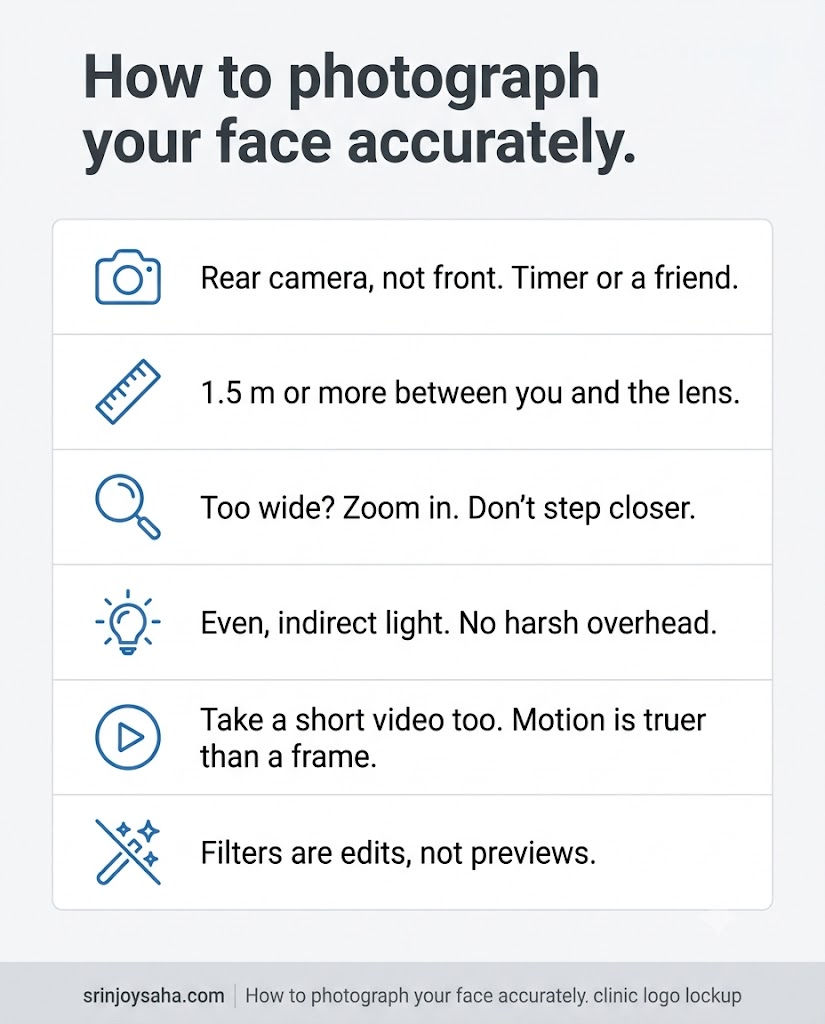
How do I photograph my face accurately?
-
Use the rear camera, not the front one, and have someone else take the photo or use a timer.
-
Put 1.5 metres or more between you and the camera. If the framing is too wide, use the phone's zoom — optical zoom if available — rather than stepping closer.
-
Use even, indirect light. Harsh overhead or direct front light manufactures shadows that read as flaws.
-
Drawing test: Draw the change you want directly onto that accurate photograph. If your line traces what is already there, the camera was the problem.
-
Take a short video as well. A face in motion is a truer reference than any single frame.
-
Treat filtered images as edits, not previews.
-
Do not bring a filter to a consultation as a surgical goal.
Thinking about a consultation?
The test is simple. Take the photograph from 1.5 metres, in even light, and look at it properly. If the feature no longer troubles you, you have your answer, and it cost you nothing.
If it still troubles you on an accurate image, that is a legitimate reason to seek a professional opinion — and a different kind of concern from the one the camera manufactured.
Bring the photograph. Bring older photographs of yourself if you are comfortable sharing them. You will get a considered assessment of what is anatomical, what is optical, and what your realistic options are — including the option of doing nothing, which is a real option and is sometimes the right one.
Frequently asked questions
Does the front camera really make my nose look bigger?
Yes. Published modelling found the nasal base appears about 30% wider at 30 cm than at 1.5 metres, and a clinical study of 30 volunteers measured the nose about 6.4% longer on close-range selfies than on standard clinical photographs.
How far away should the camera be for an accurate photo of my face?
About 1.5 metres, using the rear camera with zoom if needed. Even moving from 30 cm to 45 cm roughly halves the nasal lengthening measured in the UT Southwestern study.
Is "Snapchat dysmorphia" a real medical diagnosis?
No. It is a descriptive nickname from a 2018 medical commentary. The recognised condition is body dysmorphic disorder (BDD), which predates smartphones by decades.
What is body dysmorphic disorder?
BDD is a mental-health condition involving intense preoccupation with a perceived flaw in appearance that others see as minor or cannot see. It is treatable, usually with psychological therapy and sometimes medication.
Should I bring selfies to a cosmetic surgery consultation?
You can bring them to show what worries you, but decisions should be based on standardised photographs taken from proper distance. In my practice, planning does not proceed from a selfie alone.
Do filters show what surgery could achieve?
No. Filters are software redrawing your anatomy; they routinely produce results outside what surgery can deliver. Using a filtered image as a target sets up disappointment.
Will a surgeon refuse to operate if my concern is based only on photos?
A careful surgeon will first separate optical concerns from anatomical ones. If a concern exists only in distorted images — or if BDD is suspected — the responsible next step is reassessment or a mental-health referral, not an operation. UK and Australian guidance formalises exactly this pathway.
Is it vain to be bothered by how I look in photos?
No. No generation before ours has looked at its own face so often, and mostly through the one setup that misrepresents it. Being affected by that is human. The task is simply to judge your face on accurate evidence before acting on the feeling.
Why do I look better in the mirror than in photographs?
Two reasons, and only one is optical. A mirror shows you at conversational distance, in motion, and reversed — the face you have rehearsed since childhood. A close-range photograph shows you at 30 cm, frozen, and unreversed. The mirror is not flattering you; on the matter of distance it is the more accurate of the two. Neither is quite the face others see. A photograph from 1.5 metres is the closest you will get to that.
Does zooming in fix selfie distortion?
Only if you move back. Zoom changes framing; it does not change perspective, and perspective is set by distance alone. Optical zoom used from 1.5 metres gives you an accurate photograph. Digital zoom used from 30 cm gives you a distorted photograph, cropped.
Does "30% wider" mean my nose will look 30% smaller after surgery?
No — and this is the most common misreading. The 30% describes the photograph, not your face. Your nose does not change between the two images; only the camera's distance does. Nothing has been added for an operation to remove.
Is the rear camera really better than the front one?
Usually, but not for the reason people assume. Rear cameras tend to have better sensors and longer lenses, which helps. The larger effect is behavioural: you cannot hold a rear camera at 30 cm and see yourself, so you are forced to prop it up and step back — and the stepping back is what fixes the image.
References
-
Ward B, Ward M, Fried O, Paskhover B. Nasal Distortion in Short-Distance Photographs: The Selfie Effect. JAMA Facial Plastic Surgery. 2018;20(4):333–335. doi:10.1001/jamafacial.2018.0009. (Research letter; mathematical model.)
-
Pressler MP, Kislevitz ML, Davis JJ, Amirlak B. Size and Perception of Facial Features with Selfie Photographs, and Their Implication in Rhinoplasty and Facial Plastic Surgery. Plastic and Reconstructive Surgery. 2022;149(4):859–867. doi:10.1097/PRS.0000000000008961. PMID: 35139046. (Clinical measurement study, n=30.)
-
Rajanala S, Maymone MBC, Vashi NA. Selfies — Living in the Era of Filtered Photographs. JAMA Facial Plastic Surgery. 2018;20(6):443–444. (Viewpoint.)
-
Rice SM, Graber E, Kourosh AS. A Pandemic of Dysmorphia: "Zooming" into the Perception of Our Appearance. Facial Plastic Surgery & Aesthetic Medicine. 2020;22(6):401–402.
-
Rice SM, Siegel JA, Libby T, Graber E, Kourosh AS. Zooming into cosmetic procedures during the COVID-19 pandemic: the provider's perspective. International Journal of Women's Dermatology. 2021;7:213–216. (Survey of 100+ dermatologists.)
-
American Academy of Facial Plastic and Reconstructive Surgery, annual member surveys and press releases: 2017 (42%→55%), February 2020 (72% for 2019), February 2021 (75% for 2020).
-
Royal College of Surgeons of England. Professional Standards for Cosmetic Surgery. 2016. (Two-stage consent; cooling-off of at least two weeks.)
-
National Institute for Health and Care Excellence. Obsessive-compulsive disorder and body dysmorphic disorder: treatment. Clinical guideline CG31, 2005. Recommendations 1.4.2.3 and 1.4.2.6. nice.org.uk/guidance/cg31.
-
Medical Board of Australia / AHPRA. Guidelines for registered medical practitioners who perform cosmetic surgery and procedures. Effective 1 July 2023. (Referral, two consultations, validated BDD screening, ≥7-day cooling-off; under-18s: independent psychological evaluation and ≥3-month cooling-off.)
-
House of Commons Health and Social Care Committee. The Impact of Body Image on Mental and Physical Health. 2022; and HM Government response, 2023. (Committee survey: 80% figure.)
-
Brunton G, Paraskeva N, Caird J, et al. Psychosocial Predictors, Assessment, and Outcomes of Cosmetic Procedures: A Systematic Rapid Evidence Assessment. Aesthetic Plastic Surgery. 2014;38(5):1030–1040. It's a Department of Health–commissioned systematic review of cosmetic procedures (Institute of Education), as summarised in NHS Herts and West Essex clinical commissioning guidance on cosmetic procedures. (Cosmetic surgery often did not improve BDD and in some cases worsened it.)
Author and disclosure: This article is written by Dr Srinjoy Saha, Adjunct Professor at the Apollo Hospital Educational and Research Foundation and Senior Consultant Plastic and Reconstructive Surgeon at Apollo Multispeciality Hospital, Kolkata. He performs facial cosmetic and reconstructive procedures and has several PubMed-indexed publications, a declared interest relevant to this article.
Medical Disclaimer: This article is for education only and does not constitute medical advice, diagnosis, or a treatment recommendation. Individual suitability for any procedure can only be assessed in consultation. If concerns about your appearance are causing significant distress, please speak to a doctor or a mental-health professional.
Published July 2026 · Last reviewed 17 July 2026 by the author.