
Written and medically reviewed by Prof Dr Srinjoy Saha, MS, MCh (Plastic Surgery), FACS, FRCS (Glasgow) · Last reviewed: 30 July 2026


28+ Years Experience • 8,000+ Treatments • PSF Achauer Award • Gold Medal • Harvard-Trained
Gynecomastia is enlargement of the male breast caused by growth of glandular breast tissue. It is common, it is not a disease in itself, and in many men it settles without any treatment. In others it persists for years and does not respond to weight loss or exercise, because the tissue involved is gland rather than fat.
For most patients, this is a one-day procedure. Costs vary based on the grade of gynecomastia, typically ranging between ₹60,000 for Grade I cases requiring local anaesthesia, up to ₹3,00,000 for complex Grade III cases requiring general anaesthesia and extensive skin excision. While individual healing varies, a typical recovery involves soreness for a few days, a return to lower-body exercise in two weeks, and upper-body workouts in four to six weeks.
Representative Cases of Patient Outcomes after Gynecomastia Surgery
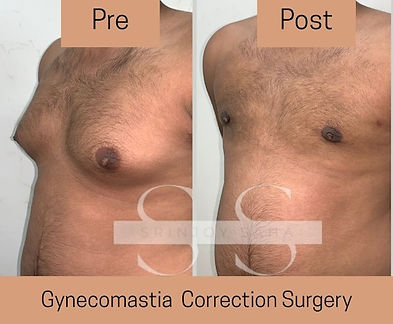
Gynecomastia correction for gland-dominant enlargement.
A 30-year-old patient had true glandular prominence that did not respond to exercise or weight loss, which he had tried for over 10 years. Surgery involved direct excision of the subareolar gland with extensive power-assisted liposuction and lipo-dissection to contour the chest. The goal was a natural, masculine chest outline with no visible signs of surgery. Results are shown after healing was complete after 6 months. Excess skin retracted satisfactorily with compression garments, and no recognisable scarring.

Gynecomastia correction with gland excision and contouring.
A 23-year-old patient had glandular prominence and mild excess fatty tissue. Surgery involved direct excision of the subareolar gland through a small peri-areolar incision, combined with power-assisted liposuction for smooth contouring. The aim was to restore a natural male chest shape with minimal scarring. The approach emphasised proportion and symmetry rather than aggressive tissue removal. Post-operative healing was uneventful, with scars concealed within the areolar border.

Targeted correction for asymmetric gynecomastia.
A 20-year-old male presented with an unilateral glandular enlargement, resulting in visible asymmetry. The treatment plan was tailored to each side: a more conservative excision on the less affected side and a slightly wider dissection on the more prominent side. The goal was to achieve a balanced chest contour without over-resection or visible scarring. Recovery was rapid, with the patient returning to normal activities within one week.
Gynecomastia, or Pseudo-gynecomastia?
The distinction determines the treatment, and it is the point most often missed.
True gynecomastia results from proliferation of glandular breast tissue. On examination it feels like a firm, rubbery, disc-shaped mass sitting directly under the nipple and areola, that does not reduce after dieting or training.
Pseudogynecomastia results from fatty deposition over the chest with no glandular growth. It is soft, diffuse, and has no discrete disc under the areola. It usually does reduce with weight loss, although loose hanging skin may remain.
Mixed is the most common presentation in adults, comprising of a glandular disc with surrounding fat. Treatment needs to address both the components. That is why performing liposuction alone often leaves a residual lump, while gland excision alone often leaves the chest full with a crater in the middle.
If you have been working out consistently but still have a firm swelling behind the nipple, it is almost certainly glandular tissue. Because it is a gland and not fat, it cannot be burned off through diet or exercise.
Differences in Patterns & Risks Shape Decisions
Skin envelope (thickness & elasticity): Thick or inelastic skin limits immediate definition and holds postoperative swelling longer. Aggressive tissue loss without accounting for the envelope can leave folds, puckering or poor nipple position.
Chest architecture (symmetry & projection): Pectoralis muscle shape, nipple–areola position and skeletal asymmetry determine final contour. Small volume differences can read very large on the chest; symmetric removal is a technical challenge.
When these factors are not planned together, revision becomes likely.
Common Surgical Pitfalls
-
Relying only on liposuction when glandular tissue is present will leave a noticeable bulge behind the areola.
-
Removing too much tissue (over-resection) can cause the chest to look hollow or irregular.
-
Failing to account for excess skin can result in uneven contours and poor nipple placement.
-
One-size technique fails when anatomy varies; planning has to be case-specific.

Skin. Fat. Gland. Fascia. Muscle.
Glandular tissue under nipple-areola complex versus fatty enlargement makes a difference.

Good Results = Balance & Harmony.
Representative chest contour after limited-access gland excision and contouring.
Different Grades of Gynecomastia
Surgical planning depends upon the extent of gland enlargement, fat excess. and skin flaccidity. A grading system — Grades I, IIa, IIb and III — was first defined in the original 1973 paper by Simon, Hoffman and Kahn, published in Plastic and Reconstructive Surgery, and remains the classification most widely used by gynecomastia surgeons today.
In Grade III, the scar burden rises, especially in Indian and South Asian skin types prone to excessive scarring. Here, the trade-off between chest contour and visible scarring has to be discussed honestly before planning any type of gynecomastia surgery.
In willing patients with Grade III gynecomastia, Prof. Srinjoy Saha utilises a specialised, minimally-invasive technique designed to reduce scar burden. This technique results in shorter scars, and is more suitable for Indian and South Asian skin conditions. Incisions are strategically placed along natural anatomical borders to minimize visible scarring, as outlined in our peer-reviewed methodology. Regenerative techniques used here are described in peer-reviewed work published in the Journal of the American College of Surgeons.
Grade | Description | Usual Approach |
|---|---|---|
I | Small enlargement, no excess skin | Gland excision, often with liposuction |
IIa | Moderate enlargement, no excess skin | Gland excision with liposuction |
IIb | Moderate enlargement with some excess skin | Excision and liposuction; skin may retract or may need addressing |
III | Marked enlargement with substantial excess skin | Excision with skin reduction and nipple repositioning |
What Prof. Saha Does Differently & Why It Matters
Prof. Srinjoy Saha's approach to gynecomastia correction focuses heavily on preserving long-term chest architecture. The goal is to provide a stable, natural-looking contour that respects your chest shape, the elasticity of your skin envelope, and the proper placement of the nipple-areola complex..
How Minimally Invasive Surgery Works in Grade III Gynecomastia:

Integrated chest planning.
A single assessment of gland, fat, skin envelope and pectoral architecture to create a bespoke surgical plan.
Why this matters to you:
Treating the chest as one unit reduces residual fullness and supports natural skin re-draping.
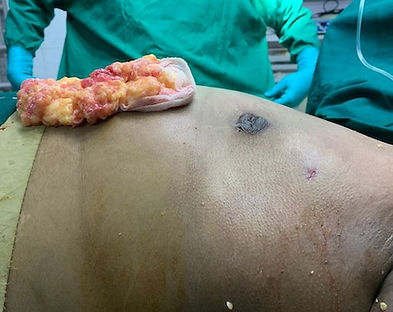
Limited-access gland excision to enable barely recognisable scars.
Small, strategically placed incisions give direct access for selective excision of firm subareolar gland.
Why this matters to you:
Enables targeted removal while placing scars where they are least conspicuous.

Precision-assisted liposuction.
Controlled, power-assisted techniques refine transitions around the pectoral margins and remove surrounding adipose fatty tissues uniformly.
Why this matters to you:
Smooth transitions lower the risk of abrupt contour steps or surface irregularities.

Upper-chest lipo-dissection rather than indiscriminate liposuction.
Guided removal of fatty tissue preserves fascial support and maintains the natural projection of the upper chest.
Why this matters to you:
Prevents a sunken or hollowed appearance of the upper chest after reduction.

Preservation of nipple–areola support and mobility.
Dissection and closure prioritise the structural support of the nipple–areola complex to avoid tethering or distortion.
Why this matters to you:
Keeps the areola-looking natural in position and movement, less distortion.

Judgement-led, measured tissue removal to avoid contour deformity.
Tissue excision is balanced against the risk of hollowing; reduction is tempered by anatomical preservation.
Why this matters to you:
Lowers the chance of crater deformity and reduces the likelihood of revision.
What Causes Gynecomastia
Gynecomastia results from a shift in the balance between oestrogen and androgen activity in breast tissue. Several things can produce that shift.
Natural hormonal shifts:
Most cases naturally occur during three distinct phases of life.
Newborns often have it due to maternal hormones, but it resolves within weeks. During puberty, many boys develop some breast tissue that usually settles on its own over 1–3 years.
Finally, in later adult life, falling testosterone and rising body fat can trigger it again.
Medications:
A surprisingly long list of prescription drugs can cause glandular growth. It is always worth reviewing your medications before considering surgery.
Common culprits include:
-
Anti-androgens and 5-alpha-reductase inhibitors.
-
Spironolactone.
-
Certain antipsychotics and antidepressants.
-
Acid-suppressing drugs.
-
Some chemotherapy agents.
-
Certain antiretrovirals.
-
Calcium channel blockers
Anabolic steroids. A frequent cause in men who train. Exogenous testosterone converts to oestradiol, and the gland that develops does not regress when the steroid stops. Gynecomastia in a current or former steroid user is likely to recur after surgery if use continues.
Other substances. Alcohol, in the context of liver disease. Cannabis, with weaker evidence.
Medical conditions. Chronic liver disease, chronic kidney disease, hyperthyroidism, hypogonadism, and — uncommonly but importantly — testicular, adrenal or pituitary tumours.
Idiopathic. In a proportion of men no cause is identified.
When gynecomastia needs prior investigation
Most gynecomastia is benign and needs no imaging. Some presentations do need assessment first, and proceeding straight to surgery in those cases is the error to avoid.
Assessment is warranted where there is:
- A hard or fixed lump, rather than the soft rubbery disc of gynecomastia.
- Swelling clearly off-centre from the nipple rather than concentric around it.
- One side only, particularly if it appeared quickly.
- Discharge from the nipple, especially if bloodstained.
- Skin dimpling, tethering, ulceration, or nipple retraction.
- Enlarged lymph nodes in the armpit.
- A testicular lump found on examination.
Klinefelter syndrome: It presents with persistent gynecomastia, is frequently undiagnosed into adulthood, and carries raised male breast cancer risk.
Male breast cancer is uncommon but it exists, and it presents as a breast lump. Any of the above means imaging and, where indicated, a tissue diagnosis before an aesthetic operation is discussed.
Blood tests are directed by the history rather than done routinely — liver and kidney function, thyroid function, testosterone, LH, oestradiol, hCG and prolactin where the picture suggests them.
What can be done without surgery
-
Treat the underlying cause first.
If a specific medication is responsible, simply changing your prescription (in consultation with your doctor) may allow the tissue to regress, especially if the gynecomastia is recent. If an endocrine or liver condition is the root cause, treating that takes priority.
-
Give it time (for adolescents).
Because pubertal gynecomastia usually resolves on its own, operating too early is an avoidable mistake. Unless the enlargement is severe or causing significant distress, a defined period of observation is the smartest first step.
-
Try weight loss (for fat-predominant chests).
Diet and exercise are highly effective if the problem is purely fat (pseudogynecomastia). However, if you have true glandular tissue, this will be ineffective. A systematic review of 24 different studies found tamoxifen to be an effective and well-tolerated medical option for select patients, while confirming that surgery remains necessary when drug treatment fails or the condition recurs, as reported in Frontiers in Pediatrics.
Clinical practice guidelines recommend surgery specifically for long-standing, fibrotic gynecomastia that has not responded to medical therapy, particularly where it is causing psychological distress, with technique tailored to severity and the amount of tissue present, as reported in the Journal of Endocrinological Investigation.
Limitations of medical treatments for gynecomastia to be clear about:
Once gynecomastia has been present beyond roughly a year, the tissue becomes fibrous, and at that stage medical measures and weight loss do not reduce it. Surgery is what removes established glandular tissue. There is no medicine that dissolves it.
Who Gets the Best Results After a Gynecomastia Surgery?
We successfully correct a wide variety of chest profiles. If your situation sounds like one of these, surgery is likely a strong option:

1
Puffy areola due to glandular prominence.
If the main issue is a glandular prominence directly behind the nipple, a small, targeted excision is sufficient to flatten the mound.
2
Mixed glandular and fatty fullness.
This is the most commonly seen presentation. To get a smooth, uniform result across the whole chest, we combine direct gland excision with chest contouring and targeted liposuction.
3
Fat-predominant chest enlargement.
If there is minimal gland tissue, we can skip the excision entirely and focus on targeted liposuction to smooth out the chest wall.
4
One-sided prominence causing asymmetry.
Having one side larger than the other is completely normal. We tailor the surgical plan to correct the mismatch without over-reducing the larger side.
5
Skin excess with low areolar position.
If significant weight loss has left you with loose skin, simply removing the gland isn't enough. We will need to actively manage the skin envelope to achieve a firm, natural contour.
6
Fullness after prior surgery elsewhere.
If you’ve had surgery elsewhere and aren't happy with the result, revision is possible. It requires a very careful assessment of your existing scar tissue and a measured, customised plan.
Who Gynecomastia Surgery Doesn't Suit - Yet?

Sometimes, the best surgical decision is choosing to wait. In the following situations, my advice is to hold off or treat the underlying cause first—because it is the medically right thing to do, not because a surgery couldn't physically be done.
1
Recent enlargement during adolescence.
Most pubertal gynecomastia actually settles on its own within one to three years. Unless the enlargement is unusually severe or causing deep distress, a period of observation is always the right first step.
2
Weight still fluctuating.
We judge your final contour against your current frame. If you are mid-way through a major weight loss or gain journey, the result you agree to today won't match your body a year from now. You need to stabilise your weight first, operate later.
3
Active use of anabolic steroids.
Exogenous testosterone converts to estrogen, which fuels gland growth. If we operate while steroid use continues, the tissue is likely to return. I always tell patients: paying for a result that won't last doesn't make sense.
Note: Once a gland has been present for over a year, the tissue becomes fibrous. At that point, neither waiting nor weight loss will reduce it, and surgery becomes the only definitive option.
Gynecomastia Correction Surgery Types
-
Liposuction alone: Best suited for a fat-predominant chest with minimal glandular tissue. We use small access incisions, usually hidden in the fold beneath the chest or at the edge of the areola.
-
Direct Gland Excision: We use this to remove the firm glandular disc through a short, inconspicuous incision at the lower border of the areola. Crucially, a thin layer of tissue must be deliberately left behind the nipple—removing everything creates a depressed, saucer-shaped hollow that is incredibly difficult to correct later.
-
Combined Excision and Liposuction: This is our standard approach for mixed gynecomastia. It allows us to address both the glandular disc and the surrounding fat as one single, smooth contour.
-
Gland Excision with Skin Reduction: Necessary for Grade III gynecomastia or for men who have experienced massive weight loss. Because this requires removing excess skin, it produces longer scars and may involve repositioning the nipple.
-
Anaesthesia: Decided by the consultant anaesthetist after assessment — most cases are done under general anaesthesia or intravenous sedation with local infiltration. Most men go home the same day. Surgery is performed at accredited hospitals including Apollo, Kolkata's only JCI-accredited hospital.
Note: Excised gland tissue does not regrow. Fat cells removed do not return, though remaining fat cells elsewhere on the chest can enlarge after substantial weight gain. Glandular tissue removed is sent for histopathology to check for any dysplasia or malignancy.
Recovery After Gynecomastia Surgery
A compression garment is worn continuously for at least 4–6 weeks — to control swelling and help the skin settle to the new contour.
Most men return to desk work within a few days. Driving resumes once the compression garment is comfortable and reaction time is unaffected. Upper-body training is deferred for 6 weeks; lower body and walking resume earlier.
Swelling and firmness take months to fully settle, and the final contour is not apparent at two weeks. Numbness around the nipple is common early and usually recovers over weeks to months.
Discomfort in the first days is managed with oral analgesia. Some bruising is expected.
In a 14-year review of nearly 5,000 gynecomastia surgery patients, the overall 30-day complication rate was 4.4%, with higher BMI, prior sepsis and bleeding disorders identified as independent risk factors, as reported in Aesthetic Plastic Surgery.
Realistic Expectations: What Gynecomastia Correction Can — And Cannot — Do
A considered, structural approach prioritises long-term stability over dramatic, short-term change.
Here is exactly what you should expect from your procedure:
-
We aim for proportion, not absolute perfection. The goal is a natural-looking chest that balances with the rest of your body, rather than a mathematically sculpted template. Small, subtle contour differences post-surgery are entirely normal and acceptable.
-
Your own anatomy sets the limits. Things like thick or lax skin dictate how quickly and cleanly the chest defines. If you have excess skin, we have to account for that in the surgical plan to avoid puckering or poor nipple position.
-
Healing is a gradual phase. Swelling and tissue settling happen in stages. While you will see an immediate difference, the refined contour usually takes 3 to 6 months to truly emerge, with subtle improvements continuing for up to a year.
-
Nipple sensation may temporarily change. It is very common to experience temporary numbness or transient hypersensitivity. While careful surgical technique minimizes these risks, they cannot be eliminated entirely.
-
Absolute symmetry is incredibly rare. Small anatomical differences between the left and right sides of the body exist in everyone prior to surgery. We aim for excellent visual balance, not mathematical equality.
-
Revision is always a possibility. Even with expert planning, unpredictable healing, prior surgeries, or heavy scar tissue can increase complexity. We plan meticulously to keep the risk of revision as low as possible, but it is a reality of any surgical procedure.


Risks & Complications
Every operation on this list carries risk, and a surgeon who does not discuss them has not consented you properly.
- Haematoma — collection of blood needing drainage. The most common early complication of this operation, which is why compression and activity restriction matter.
- Seroma — fluid collection, sometimes needing aspiration.
- Infection.
- Contour irregularity — including the crater deformity from over-resection behind the nipple.
- Under-correction — residual tissue that may need a second procedure.
- Asymmetry between the two sides.
- Altered or lost nipple sensation, temporary in most, lasting in some.
- Nipple or areolar tissue loss — uncommon, more relevant where the nipple is grafted.
- Scarring — including hypertrophic scars or keloid, a more frequent consideration in Indian skin, and a specific point to raise if you scar badly elsewhere.
- Recurrence where the underlying cause continues — most relevant with anabolic steroid use.
- Anaesthetic risks, assessed separately by the anaesthetist.
- Revision surgery may be needed.
A 2025 systematic review of nearly 7,500 patients across excisional gynecomastia techniques reported haematoma, seroma and nipple-necrosis rates below 6% and infection rates below 1%, supporting the safety profile of these approaches, as reported in Plastic and Reconstructive Surgery — Global Open.
Revision Gynecomastia — Correcting Prior Male Breast Reductions Done Elsewhere.
Revision gynecomastia frequently reflects incomplete gland removal, asymmetric excision or over-zealous suction that leaves contour irregularities. Correction requires careful re-assessment of scar tissue, residual gland and the skin envelope.
The aim is to create a balanced chest and stable contour while minimising additional visible scarring.
Revision Gynecomastia Case • Male, Early 30s • Operated Elsewhere.
The Challenge:
In a recent revision case, a patient in his early 30s presented to us after a failed procedure elsewhere left him mentally shattered. After researching heavily and visiting several surgeons, he came to our clinic. On examination, we found:
-
Surface irregularities on both sides of his chest.
-
Residual glandular tissue left behind.
-
Severe fibrosis and areolar tethering, as the previous surgeon relied too heavily on liposuction without proper gland excision.
The Revision Surgery:
To fix the scattered glandular remnants and nipple-areola tethering, we performed a sophisticated minimally invasive gynecomastia surgery. It was a difficult procedure requiring extensive gland excision through small incisions inside a heavily fibrosed area, but it went successfully. The approach included:
-
Limited-access re-excision of the remaining gland.
-
Power-assisted liposuction across the chest to smoothly blend the surrounding areas.
The Result:
Layered closure of the wound and scar management using vascularising nano-fat grafts preserved areolar mobility while softening the underlying tethering. After using compression garments for a few weeks, the result was a smooth transition across the chest with a barely visible scar.
The patient's final smile of satisfaction was one of the best rewards a surgeon could ask for.

Before
Frontal

After
Frontal

Before
Profile

After
Profile
Gynecomastia Surgery Cost in Kolkata
Gynecomastia surgery in Kolkata costs approximately between ₹60,000 to ₹3,00,000.
There is no fixed menu price.
A Grade I correction under local anaesthetic as a day case and a Grade III needing skin excision, a general anaesthetic and prolonged hospital stay are different operations sharing a name.
What determines your final costs:
Extent — how much gland, how much fat, whether skin excision is required.
Anaesthetic — local with sedation, intravenous sedation, or general.
Hospital facilities chosen. Private cabin is more costly than Semi-private, which is more costly than General ward.
Primary or revision — A revision surgery on an operated chest takes longer and is less predictable.
Symmetry — Whether one of the sides or both.
It is quoted after examination, because a figure quoted before examination is a figure for an operation nobody has planned yet.
Insurance Coverage: Gynecomastia surgery is sometimes covered by insurance where it is causing physical symptoms or where an underlying medical cause is documented. Cosmetic-only correction generally is not covered under insurance. Policies differ and pre-authorisation is decided by the insurer, not by the surgeon. What to gather, and when to raise it, is set out on the costs page.
Consultation fees, GST, deposits, quotation validity, revision charges and what to ask before comparing any quotation are set out in full here:→ What a quotation includes, consultation fees, insurance and revisions.
What the quoted figure includes
Surgeon's fee, anaesthetist fees, surgery and anaesthesia assistance fees, operation theatre charges, equipment charges, implants or grafts, hospitalised medicines, hospital stay, splint and dressings, consumables.
What it does not include
Pre-operative investigations, medication after discharge, post-operative care, revision surgery, travel and accommodation.
Factor | Effect On Cost |
|---|---|
Primary or revision | Revision on an operated chest is longer and less predictable |
Hospital stay | Day case is cheaper than an overnight admission |
Anaesthetic | Local, sedation or general — each changes the anaesthesia charge |
One side or both | Bilateral correction is longer |
Gland versus fat proportion | Gland excision adds operative time over liposuction alone |
Grade of gynecomastia | Higher grades need skin excision — more time, longer stay |
Checklist: Read Before You Book Your Gynecomastia Surgery Anywhere
A high-quality outcome depends on more than technical skill. Look for a surgeon who has:
Diagnosis
"Is what I have gland, fat, or both?" A vague answer means a vague plan.
Technique
Liposuction alone does not remove gland. Ask which operation, and why that one.
Margin
"How much tissue stays behind the nipple?" Not all of it, and not none. Over-resection creates a crater.
Scar
Length, position, and whether an existing scar is reused. Ask before the surgical plan, not after.
Pathology
Excised tissue should go for histopathology. Ask whether it does, and ensure it.
Trust
Senior anaesthetists, a JCI - accredited hospital, good instruments, and a person who answers calls at night.
Ten further questions to ask about the quotation itself are on the costs page.
A surgeon who names the limit in your case is telling you the truth. Every chest has some limits — skin quality, asymmetry, how long the gland has been there. A surgical plan that mentions none of them is not a proper plan, and an unplanned surgery often ends in disasters. Avoid it!
Frequently Asked Questions (FAQs)
-
Will exercise get rid of gynecomastia?
-
Gym and exercise reduces the fat component. It does not act on glandular tissue, which is why chests that are otherwise lean still show a firm disc behind the nipple.
-
-
Is it gynecomastia or just chest fat?
-
Fat is soft and spread evenly. Gland is a firmer, rubbery disc directly behind the nipple, often tender, often with a distinct edge. Most men have both. The distinction is made by examination and it decides the operation.
-
-
Can I have it at eighteen?
-
Yes, if the enlargement has been stable for a year or more. If it has appeared recently, waiting is usually better — pubertal gynecomastia often settles on its own.
-
-
Is it one operation?
-
For most men, yes.
-
-
Can it come back?
-
Excised gland does not regrow. New change can follow significant weight gain, resumed anabolic steroid use, or an untreated hormonal cause.
-
-
How visible is the scar?
-
A Grade I or II scar sits at the lower edge of the areola, three to four centimetres, where the colour change helps disguise it. Skin excision means longer scars that are visible.
-
-
Is it painful?
-
Soreness for two to four days, controlled with ordinary painkillers. Most men describe it as less than expected.
-
-
When can I go back to the gym?
-
Lower body from around two weeks, full upper body at four to six.
-
-
Do I need to bring anyone?
-
If done under anaesthesia or sedation, yes, per hospital rules. If done under local anaesthesia, no. Many men attend alone.
-
-
Will it be on my record?
-
Your clinical record, yes, as with any operation. It is confidential.
-
-
Does it require any further surgery?
-
Rarely. A carefully performed surgery with diligent postoperative care is usually sufficient. A second procedure is occasionally needed, most often where gland was left behind at the first operation. See revision gynecomastia section for more details.
-
Photographs in This Page
Every photograph in this section is of an actual patient of Prof. Dr Srinjoy Saha, published with that patient's specific written consent for publication. Images are unretouched apart from standardised cropping and lighting, and are taken under consistent conditions before and after surgery. Any image illustrating a concept rather than a patient is that of a Model.
Surgical outcomes depend on individual anatomy, skin thickness, tissue quality and healing. Individual results vary. No image here is a promise or prediction of your result.
Consult Prof. Srinjoy Saha
Prof. Srinjoy Saha is a Harvard-trained surgeon-scientist and a Member of the Regenerative Medicine Committee of the American Society of Plastic Surgeons. He is the only Adjunct Professor of Plastic Surgery in Apollo AHERF among their 245 India-wide faculty list. He is a Fellow of the Royal College of Physicians and Surgeons of Glasgow and the American College of Surgeons.
He is an experienced gynecomastia surgeon who has seen enough complications to be careful, and enough good outcomes to be calm. He analyses every case of body contouring individually, and operates accordingly. He works following a regenerative-first protocol he calls the Jyoticision™ System.
Frequently, he receives complex and revision gynecomastia cases referred from across India.
YOUR NEXT STEPS
A consultation is the best way to see exactly what he can achieve for your specific chest shape. He'll map out a clear surgical plan, talk through the recovery, and make sure you know exactly what to expect.


